Executive Insight No. 003
Your AI Agent Created It, But Who Owns It?
What Claude’s new watermark reveals about the Provenance-to-Ownership Gap
Founder & Principal Advisor | Executive Editor, THEEAIR Executive Insights
4 min read
Your company may know which AI system touched the work. That does not mean it can prove who created it, or who owns it.
As organizations move from using AI as a productivity tool to using AI agents to create business value, the way we govern content creation has to evolve. Anthropic's latest Claude update brings that issue into sharper focus.
What is the Claude update?
Anthropic says future Claude models will generate text containing a machine-detectable watermark. Supported files can also carry signed C2PA provenance metadata indicating that Claude was involved in creating or processing the file.
The objective is to make AI involvement technically detectable, but detection is not ownership.
A machine-detectable signal may indicate that AI was involved in creating or processing an asset. It does not establish who authored the original material, whether the sources used were authorized, how rights were acquired or transferred, or whether the organization has the right to publish, license or commercialize the finished work.
Anthropic's explanation reveals why this is a very important governance issue.
What happens when Claude edits human work?
Anthropic states that: The watermark only applies to words Claude chooses.
When Claude proofreads or lightly edits human-written text, Anthropic explains that there may be too little model-generated language for its involvement to be detectable. The more Claude writes, the more opportunity there is for a watermark to appear.
In other words:
A detectable watermark may indicate AI involvement. The absence of a detectable watermark does not establish that AI was not involved.
Consider a writer who uploads an unfinished manuscript to Claude and asks it to identify errors, improve the structure, strengthen unclear sections or suggest areas requiring further development.
Does that process transform the entire manuscript into an AI-generated work?
Does an undetectable watermark establish that the finished manuscript remained entirely human-created, by the author?
Neither question can be answered by examining the finished file alone.
As the author of five books, I know that a finished manuscript has a history. Behind the final work are original drafts, revisions, editorial decisions and identifiable creative choices.
AI assistance does not automatically erase the human contribution, but the finished file may not show where human contribution ends, where AI intervention begins, or how substantially the work changed.
That is the problem and where the governance question begins.
AI agents accelerate processes but complicate creation history
An employee may use Claude for a single editing task. An AI agent can operate across an entire workflow. It may research a subject, retrieve material from internal and external sources, combine information from multiple documents, generate content, revise it through several systems, convert it into different formats and move the finished asset toward publication.
By the time the work reaches its final form, the organization may possess the asset without possessing a clear record of how it was created. The watermark may be detectable, partially detectable or undetectable.
None of those outcomes explain the respective contributions of the human, the AI system and the agent.
That is the governance exposure.
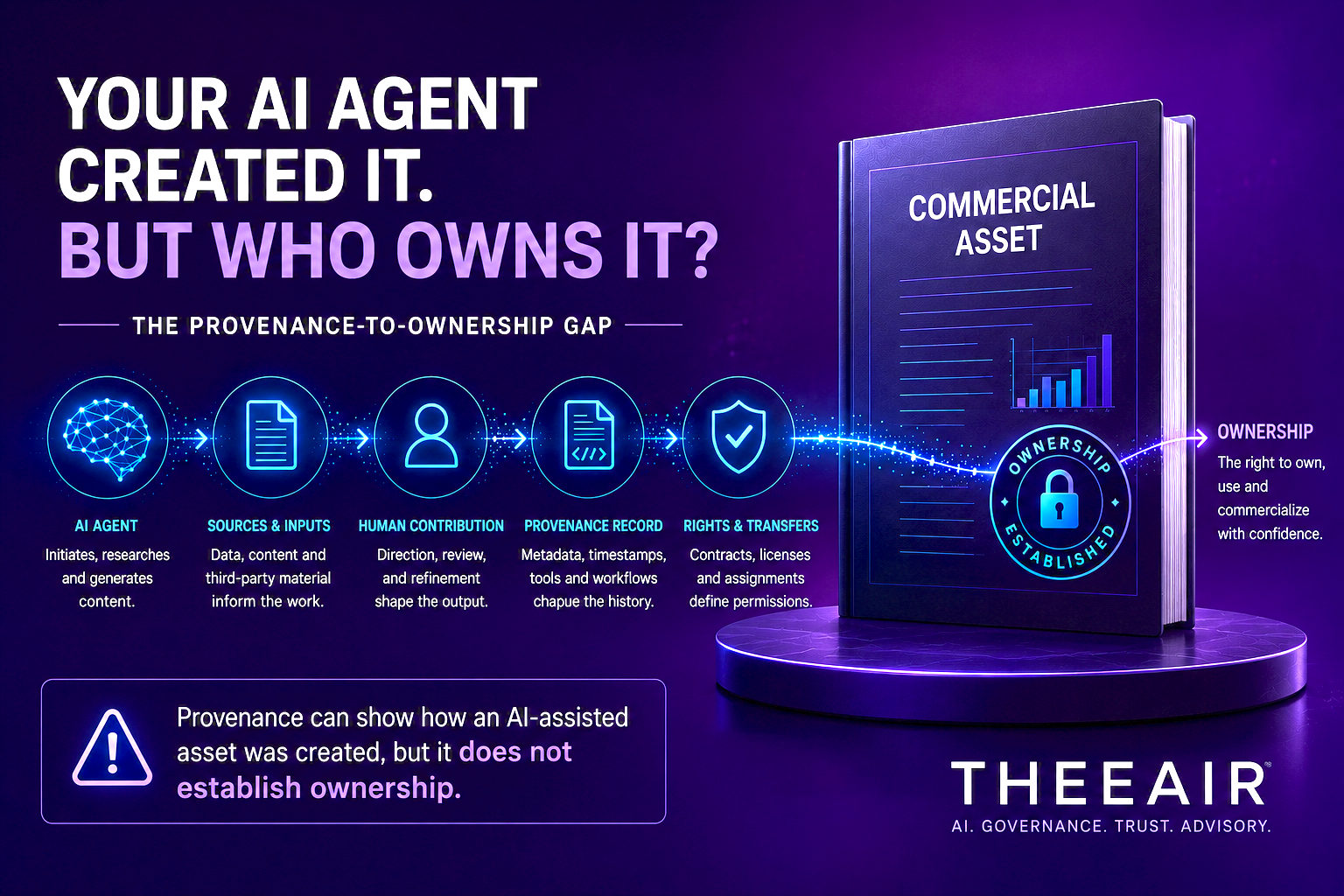
The Provenance-to-Ownership Gap
The ownership gap in this instance arises when an organization possesses an AI-assisted asset but cannot reconstruct the human contribution, source authority, AI or agent involvement, transfer of rights or basis of ownership.
Traditional copyright and chain-of-title frameworks are built around identifiable authors or legally recognized rights holders. They depend on being able to establish how a work was created, how ownership arose or was transferred, and whether its use was authorized.
AI agents complicate that chain, and make it harder to establish.
A company can possess the finished work and still be unable to close the provenance to ownership gap, and this is very important, especially when the asset is commercially valuable.
What Should Executives Do Now?
The best time to address this is before the asset becomes commercially significant, not when a buyer or client starts to ask questions.
One practical step organizations can take now is to establish a contemporaneous creation record for defined categories of commercially valuable or higher-risk AI-assisted work.
Maintain a record of how the work came into existence, what role AI played and the basis on which the organization claims the resulting asset.
Privacy professionals already understand this principle. Organizations do not wait for an audit to reconstruct how personal data moves through the enterprise. They establish records of processing activities (RoPA) as part of governance.
AI-assisted intellectual property deserves a similar discipline. The specific design of that control should reflect the organization's assets, AI solution contracts, AI environment and risk profile.
The High Priority Executive Question
Executives should be asking this question:
If challenged, could we clearly explain how this commercially valuable work was created, what AI changed, who contributed to it and why our organization claims the right to own, use and commercialize it?
If the answer is unclear, the governance gap already exists.
SOURCES & FURTHER READING
- Anthropic, “How Claude’s Text Watermark Works”. https://www.anthropic.com/news/how-claudes-text-watermark-works
- European Union, Regulation (EU) 2024/1689, Article 50. https://eur-lex.europa.eu/legal-content/EN/TXT/?uri=CELEX:32024R1689
- U.S. Copyright Office, Copyright and Artificial Intelligence, Part 2: Copyrightability, 2025. https://www.copyright.gov/ai/ai-report-part-2-copyrightability.pdf
- World Intellectual Property Organization, Rights Clearance: A Guide for Independent Filmmakers, 2026. https://www.wipo.int/publications/en/series/index.jsp?id=38
